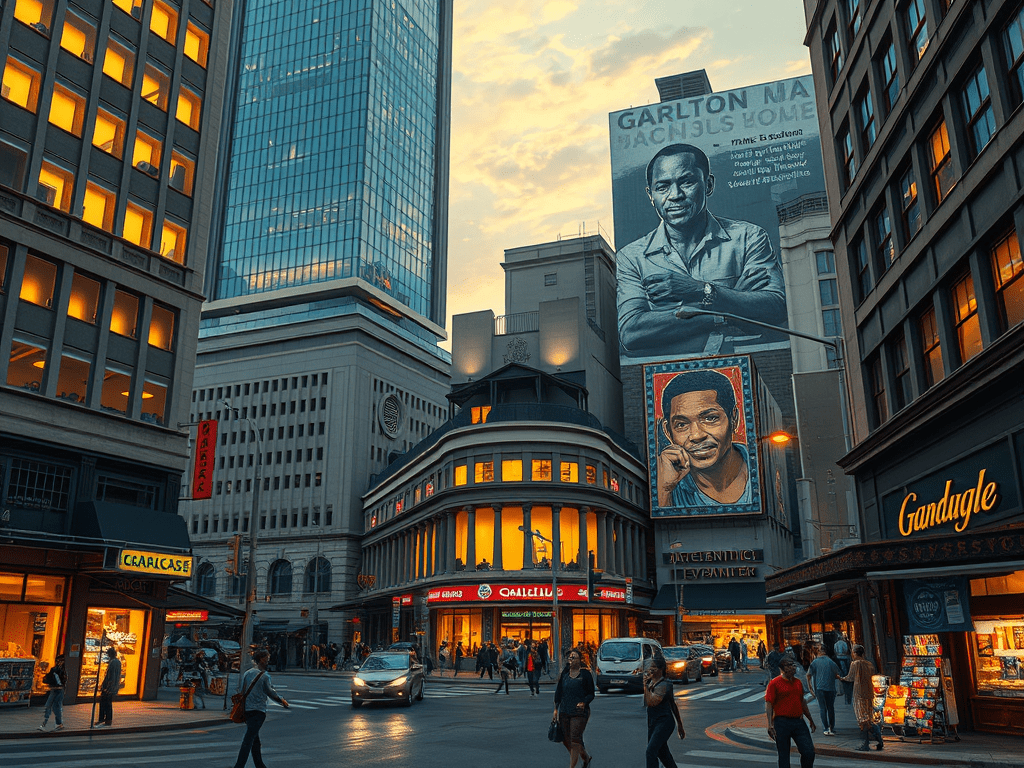
Johannesburg isn’t just a city. It’s a carefully constructed experience, a living paradox. The city of gold is a place where history and modernity collide, where glass skyscrapers cast shadows over century-old streets, and where economic inequality is woven into the very fabric of its urban landscape.
Inspired by Hackley’s (2013) chapter on psychogeography, which explores how urban spaces shape emotions, behavior, and consumer choices, I took a slow, observant walk through Joburg’s inner city, letting the environment dictate my thoughts rather than following a fixed route. Here’s what I noticed.
Egoli as a stage: you’re in the scene, but who’s directing?
Walking through Marshalltown, where corporate headquarters dominate the skyline, the first thing that stands out is the architecture. The city’s mise-en-scène is one of glass, steel, and forgotten history.
The iconic Carlton Centre, once a symbol of Joburg’s golden age, now feels like a relic of a different era, its grandeur dimmed, yet still commanding attention. As Hackley (2013) suggests, spaces are never just empty backdrops. They are engineered to make us feel, move, and consume in specific ways.
The further you walk towards Gandhi Square, the more the corporate sheen fades into chaotic, vibrant street-level commerce. Billboards fight for attention, and pavement vendors display their wares like pop-up storefronts.
Taxi hooters, fast-paced Zulu conversations, a street preacher yelling about salvation—it’s a city that refuses silence.
The artificial glow of LED signs in fast-food joints contrasts with the soft yellow hues of historic buildings still standing among the newer developments. There’s a constant interplay between the past and the present, between the spaces of the wealthy and the spaces of the working class.
Where Joburg lets you go (and where it doesn’t)
Unlike planned shopping malls where movement is designed to maximize browsing time and impulse buys, the Joburg city center is improvised. But even in the seeming chaos, there’s an underlying rhythm.
The pedestrianized areas near Newtown Junction encourage leisurely movement, but a few blocks over, at Bree Street Taxi Rank, walking turns into a high-stakes negotiation with rushing minibus taxis. The city forces you to be alert. There’s no passive strolling here.
On Commissioner Street, large brands like McDonald’s and Shoprite dominate, but in-between, informal traders carve out their own retail spaces. Johannesburg isn’t a city of strict commercial zoning. It’s a layered economy, where formal and informal businesses exist side by side.
This mix of structured corporate retail and spontaneous street-side trading creates an urban marketplace that Hackley would describe as an engineered consumer journey, where movement and spending are subtly guided, even in spaces that feel unplanned.
I pass by a mural of Hugh Masekela, reminding me that these streets have been walked by jazz legends, activists, and revolutionaries. The city isn’t just a place. It’s a narrative in motion.
Johannesburg is selling you something, whether you notice or not
Hackley’s discussion on psychogeography made me realize that Joburg isn’t just a city you live in. It’s a city that actively sells you an experience. Whether through its malls, taxi ranks, or digital billboards, it’s a marketplace wrapped in a metropolis, shaping movement, emotions, and choices just like a well-designed store layout.
For some, it’s a place of opportunity. The high-rises of Sandton, visible from certain angles, whisper of wealth and aspiration.
While others know it as a site of survival. The street vendors, the taxi drivers, the hawkers who transform sidewalks into places of economic exchange, resisting corporate dominance in a city that is always pushing forward have learnt how to make the city work for them.
For everyone, it’s a city of contradictions. A place where luxury malls and informal markets exist within minutes of each other, and where public spaces are never truly neutral. They are shaped by class, history, and power.
Johannesburg isn’t static. It moves, it breathes, and it forces you to engage with it, whether you want to or not.
 Brokebella
Leave a reply to overthinkingitagain Cancel reply