Some stories don’t come from slogans or annual reports. They come from objects. Tangible, ordinary things that carry meaning. And sometimes, what looks like nothing at all turns out to be everything.
When I sat down to think about which organisation I wanted to explore for this project, my mind kept circling back to a place that shaped my own creative roots: an independent contemporary art gallery I interned at during my final year of uni. No big name. No glossy funding. Just a cube-shaped room, a lot of passion, and a commitment to making strange things feel important.
Let me tell you the story of The White Cube.
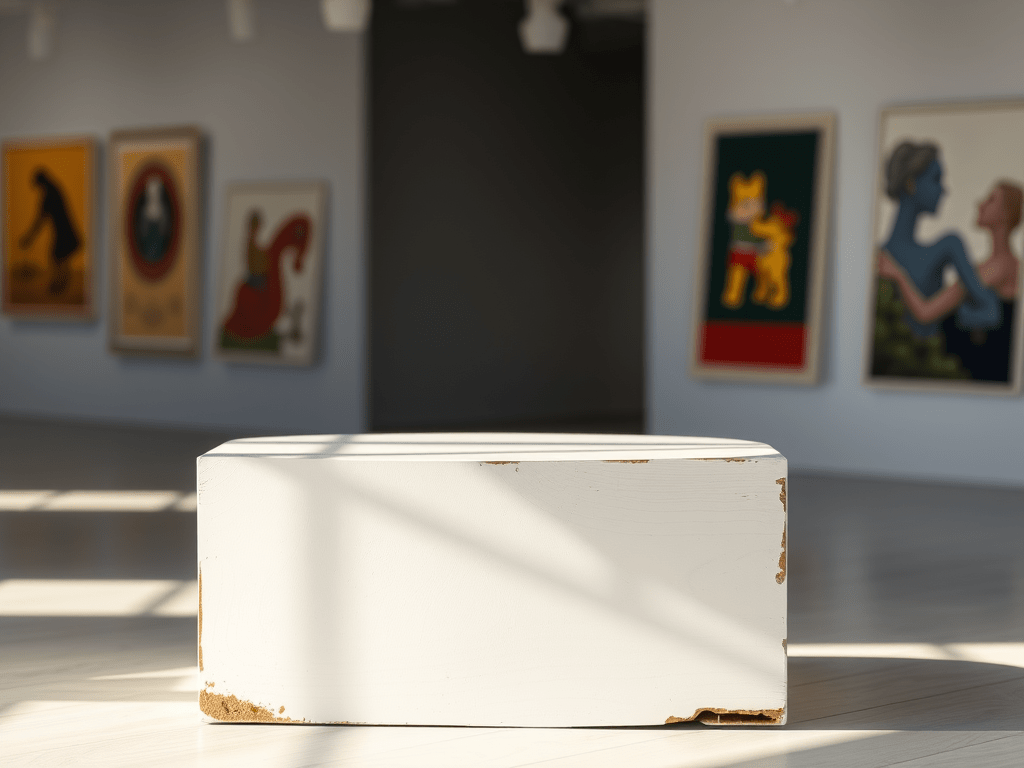
Object: A Single White Exhibition Plinth
Not a sculpture. Not the artwork itself. Just the plinth. Plain white. Wooden. About knee-high. The kind of thing that usually blends into the background. And yet, that plinth tells the entire story of the organisation.
It was scuffed around the edges, a little chipped at the base. Not quite level. But it was the one constant in a gallery space that changed every two weeks. It held ceramic pots one week and glitchy tech sculptures the next. It once held a bowl of melted ice with flower petals floating inside. Another time, just a glass of saltwater. Sometimes it held nothing at all.
But it always held space for something to be seen.
That was the gallery’s ethos in a nutshell. Give artists—especially new, emerging, unheard ones—a platform. Let the art speak for itself. Make space for people to look at the world differently. The white plinth wasn’t the main event, but without it, nothing could be elevated. Literally or metaphorically.
What It Represented in the Organisation
This single white cube represented:
- Support: Quiet, foundational, behind-the-scenes help. Just like the staff, the interns, the volunteers. Always invisible, always vital.
- Adaptability: The same object carried countless meanings depending on what sat atop it. Just like the gallery’s ability to adapt to new artists, new mediums, and new ideas.
- Intentional space-making: It reminded me that sometimes, doing less—making room, being still—is the most powerful thing you can do. The gallery wasn’t flashy. It was focused. Every square meter mattered.
- Collective creativity: That plinth had been built by one of the artists, repaired by a visiting lecturer, painted by three different interns. It carried fingerprints, paint drips, and history. It wasn’t a mass-produced fixture. It was ours.
Why It Still Stays With Me
I think about that white cube more than I probably should. I think about what it means to hold space for people. To work behind the scenes. To believe that just because something looks quiet doesn’t mean it isn’t powerful.
That gallery taught me that leadership doesn’t always stand in the spotlight. Sometimes it crouches behind a wonky plinth with a paintbrush, making sure someone else’s work gets seen.
And as someone now growing roots in the digital world—content, SEO, storytelling, structure—I still carry that mindset with me. Build clean foundations. Elevate what matters. Know when to get out of the way.
My take:
We tend to tell the story of organisations through founders and logos and funding rounds. But sometimes the soul of the place is in a scuffed white box with years of paint layers and quiet pride built in.
The object might be small, but the story it holds? Massive.
If you’ve ever worked somewhere that left a quiet mark on you—or found meaning in something mundane—I’d love to hear about it. Let’s build this hi(story) together, one object at a time.
 Brokebella
Comment